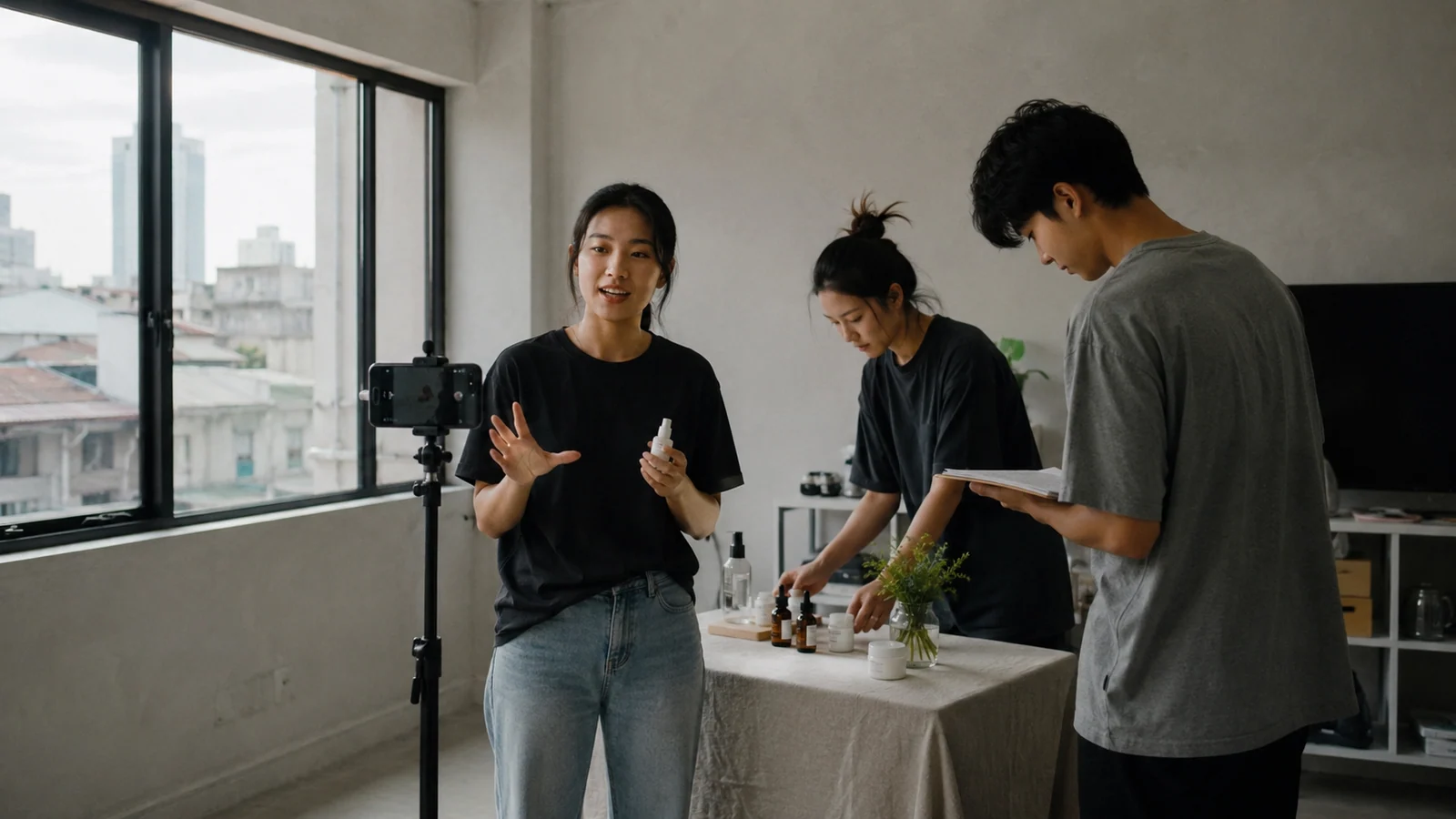
Localization is not translation. A Thai UGC campaign needs to sound as if it was conceived for a Thai viewer, not converted after the creative decisions were already made.
Start with the buying context
Ask where the viewer will encounter the video and what they can do next. A TikTok Shop demonstration, a YouTube education video, a LINE follow-up, and a landing-page testimonial need different pacing and CTAs.
Define:
- audience age and region,
- platform and placement,
- product category,
- level of familiarity,
- price sensitivity,
- and the next action available in Thailand.
Choose a creator for trust, not decoration
The creator should feel plausible for the product and claim. Consider communication style, perceived expertise, age, setting, and energy.
CelestiAI includes Thai UGC creator examples so teams can compare several directions before generation. Use a friendly lifestyle persona for everyday demonstrations, a specialist persona for considered purchases, and a founder persona for authority content.
Rewrite the idea in spoken Thai
Literal translation often creates long sentences and formal transitions. Start from the meaning and rewrite for speech.
Practical rules:
- Use one idea per sentence.
- Prefer familiar spoken phrasing where it fits the brand.
- Keep English product terms only when the audience commonly uses them.
- Read prices, units, and abbreviations aloud before approval.
- Decide whether polite particles support the creator's persona and context.
- Avoid mixing levels of formality inside one short video.
The final script should be reviewed by a fluent Thai speaker familiar with the audience—not only by a translator.
Localize the hook
The hook should reflect a real local situation. Do not add “in Thailand” to a generic global script and call it localization.
Instead, adapt the friction:
- the platform behavior,
- delivery expectation,
- payment or purchase flow,
- weather or daily routine when relevant,
- and how Thai viewers discuss the category.
Generate and review the voice
Use a Thai voice that matches the creator. Listen for:
- tone marks and word boundaries,
- English loanword pronunciation,
- product names,
- number reading,
- unnatural pauses,
- and whether the energy feels credible.
If one sentence repeatedly sounds wrong, rewrite it. Text-to-speech quality improves when the input is designed for speech.
Subtitle for mobile viewing
Thai subtitles need comfortable line length. Do not split a phrase at an unnatural point just to fill two equal lines. Keep sufficient contrast and leave UI-safe margins for each platform.
Use subtitles to support comprehension, not to reproduce every visual decoration from a global template.
Localize the offer and CTA
The offer must match what the viewer can actually access. Verify price, currency, shipping area, promotion dates, product availability, and the exact destination after tapping.
Good CTAs describe the next action:
- ดูตัวอย่างเต็ม
- ลองสร้างวิดีโอแรก
- ดูวิธีใช้งานทีละขั้นตอน
- เปรียบเทียบแพ็กเกจ
Choose phrasing that fits the brand's normal voice.
Run a Thai creative review
Before distribution, ask:
- Does this sound originally Thai?
- Does the creator fit the category?
- Is any claim unnatural or too aggressive?
- Are subtitles easy to read on a phone?
- Does the CTA match the real local journey?
Build a local testing matrix
Test creative variables separately. Start with three Thai hooks for the same body and offer. Then compare two creator personas. Finally test the CTA. This tells you whether performance changed because of language, messenger, or offer.
Thai UGC performs best when localization begins at strategy—not after production.
Browse Thai UGC creators in CelestiAI and use the script framework to plan your first variations.